



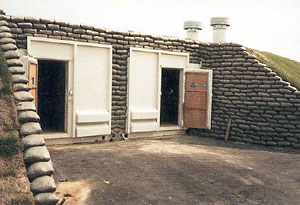
The Federal explosives regulations at 27 CFR, Part 555, Subpart K, provide specific requirements for explosives storage magazines. This webpage is intended to provide information that may be useful to Federal explosives licensees and permittees.
Pursuant to 27 CFR § 555.205, all explosive materials must be kept in locked magazines that meet the standards in 27 CFR, Part 555, Subpart K – Storage, unless they are:
- In the process of manufacture;
- Being physically handled in the operating process of a licensee or user;
- Being used; or
- Being transported to a place of storage or use by licensee or permittee or by a person who has lawfully acquired explosive materials under 27 CFR § 555.106.
Explosive materials that are not subject to the above conditions and are not otherwise exempt pursuant to 27 CFR § 555.141 and 27 CFR § 555.32, must be stored in accordance with all prescribed storage requirements in 27 CFR, Part 555, Subpart K – Storage.
ATF defines “explosives” as “any chemical compound mixture, or device, the primary or common purpose of which is to function by explosion”. 18 U.S.C. 841(d).
For the purposes of subsections (d), (e), (f), (g), (h), and (i) of 18 U.S.C. 844, the term “explosive” means gunpowders, powders used for blasting, all forms of high explosives, blasting materials, fuzes (other than electric circuit breakers), detonators, and other detonating agents, smokeless powders, other explosive or incendiary devices within the meaning of paragraph (5) of section 232 of this title, and any chemical compounds, mechanical mixture, or device that contains any oxidizing and combustible units, or other ingredients, in such proportions, quantities, or packing that ignition by fire, by friction, by concussion, by percussion, or by detonation of the compound, mixture, or device or any part thereof may cause an explosion. 18 U.S.C. 844(j).
For purposes of 27 CFR, Part 555, ATF classifies explosive materials into the following classes:
High Explosives
Explosive materials which can be caused to detonate by means of a blasting cap when unconfined. 27 CFR § 555.202.
Low Explosives
Explosive materials which can be caused to deflagrate when confined. 27 CFR § 555.202.
Blasting Agent
Any material or mixture, consisting of fuel and oxidizer, that is intended for blasting and not otherwise defined as an explosive; if the finished product, as mixed for use or shipment, cannot be detonated by means of a number 8 test blasting cap when unconfined. 27 CFR § 555.11.
As required in 18 U.S.C. 841(d) and 27 CFR § 555.23, ATF annually publishes a List of Explosive Materials in the Federal Register. While the list is comprehensive, it is not all-inclusive. The fact that an explosive material may not be on the list does not mean that it does not meet the definition of “explosive materials” in 18 U.S.C. 841. Explosive materials are listed alphabetically by their common names, followed by chemical names and synonyms in brackets.
Explosive materials that are not subject to the conditions in 27 CFR § 555.205 and that are not otherwise exempt pursuant to 27 CFR § 555.141 and 27 CFR § 555.32, must be stored in a magazine described below based on the class of explosive material. Refer to 27 CFR § 555.203.
Type 1 Magazine
Permanent magazines for the storage of high explosives. Other classes of explosive materials may also be stored in type 1 magazines. Must meet the construction requirements prescribed in 27 CFR § 555.207.
Type 2 Magazine
Mobile and portable indoor and outdoor magazines for the storage of high explosives. Other classes of explosive materials may also be stored in type 2 magazines. Must meet the construction requirements in 27 CFR § 555.208.
Type 2 Detonator Boxes must meet the construction requirements in 27 CFR § 555.208(c) and can only be used for the storage of up to 100 detonators.
Type 3 Magazine
Portable outdoor magazines for the temporary storage of high explosives while attended (for example, a “day-box”). Other classes of explosives materials may also be stored in type 3 magazines. Explosive materials cannot be left unattended in a type 3 magazine and must be removed to an appropriate magazine (i.e. type 1, type 2, type 4, type 5) for unattended storage. Must meet the construction requirements in 27 CFR § 555.209.
Type 4 Magazine
Magazines for the storage of low explosives. Detonators that will not mass detonate and blasting agents may also be stored in type 4 magazines. Must meet the construction requirements in 27 CFR § 555.210. Detonators that will not mass detonate can only stored with explosive materials listed in 27 CFR § 555.213(b)(1).
Type 5 Magazine
Magazines for the storage of blasting agents only. Must meet the construction requirements in 27 CFR § 555.211.
ATF Magazine-Related Rulings
- ATF Ruling 75-21: Provides guidance on type 1 magazines with smooth finished concrete floors that were constructed under contract for use by the U.S. Department of Defense (DoD) or that meet or exceed the DoD construction specifications.
- ATF Ruling 76-18: Provides bullet-resistant construction options for type 1 and type 2 magazines.
- ATF Ruling 2004-3: Allows indoor type 4 magazines to be secured with flush mount bolt-style locks utilizing interlocking solid metal parts, each affixed securely to the magazine in such a way that they cannot be readily removed from the exterior of the magazine and each locking mechanism having at least five tumblers.
- ATF Ruling 2007-3: Allows for the temporary storage of bulk blasting agents in type 5 mobile delivery vehicles provided certain conditions are met.
- ATF Ruling 2010-7: Allows the storage of loaded perforating guns outside of locked magazines provided certain conditions are met.
- ATF Ruling 2011-2: Allows for alternate locking methods for outdoor type 5 bins and silos containing bulk blasting agent.
- ATF Ruling 2011-3: Allows for magazines to be secured with hidden-shackle “hockey puck” locks, recessed padlocks, and padlocks with boron alloy shackles.
- ATF Ruling 2012-5: Allows the storage of explosive materials in type 4 magazines with wood-only floors, provided certain conditions are met.
- ATF Ruling 2022-2: Allows the storage of explosive materials in remote avalanche control systems, provided certain conditions are met.
- Are generally prohibited in residences and dwellings.
- ATF Ruling 2002-3: Provides guidance on the requirements to apply for a variance to store explosives in a residence or dwelling.
- ATF Ruling 2002-4: Provides guidance on the need for a variance for the indoor storage of explosive materials in business premises directly adjacent to a residence or dwelling.
- The total quantity of explosive materials stored within all indoor magazines inside one building is limited to 50 pounds.
- The total quantity of detonators stored within each indoor magazine is limited to 5,000.
- The doors on indoor magazines located in secure rooms must only be secured with one steel padlock that need not be protected by a ¼-inch thick steel hood. A room is only considered “secure” when it is locked exactly as a magazine (e.g. two mortise locks, three-point lock, etc.).
ATF Notification (27 CFR § 555.63)
Federal explosives licensees and permittees (FEL/Ps) who acquire or construct a new explosives storage magazine must notify ATF by telephone or in writing. If notification is done in writing, the FEL/P must provide notification at least 3 business days in advance of constructing a new magazine and at least 5 business days in advance of acquiring a new magazine.
An FEL/P who intends to make changes in construction to an existing magazine must also notify ATF by telephone or in writing. If notification is done in writing, the FEL/P must provide notification at least 3 business days in advance of making changes in construction to an existing magazine and at least 5 business days in advance of using any reconstructed magazine. Changes in construction may commence after explosives are removed from the magazine. However, explosives may not be stored in a reconstructed magazine prior to notifying ATF that the changes have been completed.
Before repairing the interior of magazines, all explosive materials must be removed and the interior cleaned. Before repairing the exterior of magazines, all explosive materials must be removed if there exists any possibility that repairs may produce sparks or flame. Explosive materials removed from magazines under repair must be (a) placed in other magazines appropriate for the storage of those explosive materials under this subpart, or (b) placed a safe distance from the magazines under repair where they are to be properly guarded and protected until the repairs have been completed. Refer to 27 CFR § 555.216.
These notification requirements do not apply to the temporary storage (i.e., under 24 hours) of explosive materials or to the storage of blasting agents in mobile or portable type 5 magazines.
Magazines are considered suitable for the storage of explosives provided all other requirements in 27 CFR, Part 555, Subpart K – Storage are met.
Fire Authority Notification (27 CFR § 555.201)
Any person who stores explosive materials must notify the authority having jurisdiction for fire safety in the locality in which the explosive materials are being stored. Notification must include the type, magazine capacity, and location of each site where such explosive materials are stored. Such notification shall be made orally before the end of the day on which storage of the explosive materials commenced and in writing within 48 hours from the time such storage commenced.
The Federal explosives regulations, as prescribed in 27 CFR § 555.206, require explosives storage magazines to be located certain minimum distances from inhabited buildings, highways, passenger railways, and other magazines based on the quantity of explosive materials in each magazine. These tables of distances are designed to protect the public in the event of a magazine explosion.
- The tables of distances generally apply to the outdoor storage of explosive materials.
- When determining the distance from a magazine to a highway or an inhabited building, an individual must measure from the nearest edge of the magazine to the nearest edge of the highway or inhabited building.
- If any two or more magazines are separated by less than the specified distance, then the weights in the magazines must be combined and considered as one.
- Explosive materials not subject to the activities in 27 CFR § 555.205 must be stored in a magazine that meets the table(s) of distances based on the class or type of explosive material.
- 27 CFR § 555.218 – Storage of high explosives, blasting agents, bulk salutes and more than 10,000 pounds of display fireworks.
- 27 CFR § 555.219 – Storage of low explosives.
- 27 CFR § 555.220 – Storage of high explosives and blasting agents from ammonium nitrate and blasting agents.
- 27 CFR § 555.224 – Storage of 10,000 pounds or less of display fireworks (except bulk salutes).
- The storage of blasting agents and ammonium nitrate, when located in the proximity of high explosives or other blasting agents, is subject to the distance limitations prescribed in the tables of distances at 27 CFR 555.218 and 555.220. View guidance on how to apply these tables.
A single magazine (or group of magazines considered as one for table of distance purposes) cannot contain more than 300,000 pounds of explosive materials or more than 20 million detonators. Federal explosives licensees and permittees can submit variance requests to exceed these amounts provided the conditions in 27 CFR § 555.22 are met. View more information on how to request a variance.
ATF Table of Distance-Related Rulings
- ATF Ruling 75-20: Clarifies that offices or repair shops used in connection with the manufacture, transportation, storage, or use of explosive materials are not inhabited buildings.
- ATF Ruling 2005-2: Provides guidance on private roads subject to the tables of distances.
- ATF Ruling 2005-3: Provides guidance on inhabited buildings subject to the tables of distances.
Barricades
Under certain tables of distances, barricades can reduce the minimum required distance from exposed sites, such as inhabited buildings. Barricading is the effective screening of a magazine containing explosive materials from another magazine, an inhabited building, a passenger railway, or a highway, either by a natural barricade or by an artificial barricade.
Natural barricades, as defined in 27 CFR § 555.11, are “Natural features of the ground, such as hills, or timber of sufficient density that the surrounding exposures which require protection cannot be seen from the magazine when the trees are bare of leaves.”
An artificial barricade, as defined in 27 CFR § 555.11, is “An artificial mound or revetted wall of earth of a minimum thickness of three feet, or any other approved barricade that offers equivalent protection.”
To be properly barricaded, a straight line from the top of any sidewall of the magazine containing explosive materials to the eave line of any other magazine or building, or to a point 12 feet above the center of a railway or highway, will pass through the natural or artificial barricade.
Type 1 (27 CFR § 555.207), Type 2 (27 CFR § 555.208), Type 4 (27 CFR § 555.210), Type 5 Magazines (27 CFR § 555.211)
Each door on type 1, type 2, type 4, and type 5 explosives storage magazines containing explosive materials subject to 27 CFR, Part 555 – Commerce in Explosives must generally be secured with one of the following methods:
- Two mortise locks.
- A mortise lock that requires two keys to open.
- Two padlocks fastened in separate hasps and staples.
- A combination of a mortise lock and a padlock.
- A three-point lock.
If padlocks are used, they must have at least 5 tumblers and at least a ⅜-inch thick case-hardened or boron alloy shackle. Padlocks must also be protected with at least ¼-inch thick steel hoods constructed to prevent the sawing or lever action on the padlocks, including the lock hasps and staples.
The locking requirements do not apply to doors that are adequately secured on the inside by means of a bolt, lock, or bar that cannot be actuated from the outside.
The doors on indoor magazines located in secure rooms must only be secured with one steel padlock that need not be protected by a ¼-inch thick steel hood. A room is only considered “secure” when it is locked exactly as a magazine (e.g. two mortise locks, three-point lock, etc.).
Each door on type 5 vehicular magazines (e.g., trailers, semitrailers) must only be secured with one steel padlock that need not be protected by a ¼-inch thick steel hood. Refer to 27 CFR § 555.211(a)(4).
Vehicular magazines must also have their wheels removed or be immobilized by a kingpin locking device.
Type 2 Detonator Boxes and Type 3 Magazines
- Each door must be secured with one steel padlock that has at least 5 tumblers and at least a ⅜-inch thick case-hardened or boron alloy shackle. Refer to 27 CFR § 555.208(c) and 27 CFR § 555.209.
Magazine Inspections
All persons storing explosive materials must inspect their magazines at least every seven days. An inventory of the explosive materials is not required, but the inspection must be sufficient to determine if there has been unauthorized entry or attempted entry into the magazine, or unauthorized removal of the explosive materials within the magazine. Magazine inspections are only required when explosive materials are stored in the magazine. Refer to 27 CFR § 555.204.
ATF Lock-Related Rulings
ATF Ruling 2004-3: Allows indoor type 4 magazines to be secured with flush mount bolt-style locks utilizing interlocking solid metal parts, each affixed securely to the magazine in such a way that they cannot be readily removed from the exterior of the magazine and each locking mechanism having at least five tumblers.
ATF Ruling 2011-2: Allows for alternate locking methods for outdoor type 5 bins and silos containing bulk blasting agent.
ATF Ruling 2011-3: Allows for magazines to be secured with hidden-shackle “hockey puck” locks, recessed padlocks, and padlocks with boron alloy shackles.
Smoking, matches, open flames, and spark producing devices are not permitted: 1) in any magazine; 2) within 50 feet of any outdoor magazine; and 3) within any room containing an indoor magazine. 27 CFR § 555.212.
Generally, detonators cannot be stored in the same magazine with other explosive materials. Detonators that will not mass detonate can be stored in a type 4 magazine with electric squibs, safety fuse, shock tube, igniters, and igniter cord. All detonators can be stored in a type 1 or type 2 magazine with delay devices, electric squibs, safety fuse, shock tube, igniters, and igniter cord. 27 CFR § 555.213.
The following requirements apply only to the storage of explosive materials in type 1, type 2, type 3, and type 4 magazines. 27 CFR § 555.214.
- Explosive materials cannot be placed directly against interior magazine walls.
- Containers of explosive materials must be stored so the marks of identification are visible.
- ATF Ruling 2010-2 allows containers of explosive materials to be stored without the marks of identification being visible provided certain conditions are met.
- ATF Ruling 2012-2 allows display fireworks to be stored in fixed, unmarked, and uncovered bins inside explosives storage magazines.
- Metal containers of explosive materials must not be unpacked or repacked inside a magazine or within 50 feet of a magazine, and must not be unpacked or repacked close to other explosive materials.
- Containers of explosive materials must remain closed while being stored.
- Tools used to open or close containers of explosive materials must be made from nonsparking materials. Metal slitters can be used to open fiberboard containers.
- Metal tools, except for nonsparking transfer conveyors, cannot be stored in any magazine containing high explosives.
The following requirements apply to the interior of all magazines. 27 CFR § 555.215 and 27 CFR § 555.217.
- Magazines must be kept clean and dry. They must remain free of grit, paper, empty packages and containers, and rubbish.
- Brooms and other utensils used in the cleaning and maintenance of magazines must have no spark-producing metal parts.
- Magazine floors stained by leaking explosive materials must be cleaned according to the explosives manufacturer’s instructions.
- Deteriorating explosive materials must be destroyed according to the explosives manufacturer’s instructions.
- Battery-activated safety lights/lanterns may be used in magazines.
- Electric lighting must meet the standards prescribed by the National Electrical Code for the conditions present in the magazine at any time.
- Electrical switches must be located on the outside of the magazine.
The following requirements apply to areas around the magazines. 27 CFR § 555.215.
- A 25-foot perimeter around the magazine must be kept free of rubbish, brush, dry grass, and trees (except live trees over 10 feet tall).
- Volatile materials are restricted from being within 50 feet of any outdoor magazine.
Before repairing the interior of magazines, all explosive materials must be removed and the interior cleaned. Before repairing the exterior of magazines, all explosive materials must be removed if there exists any possibility that repairs may produce sparks or flame. Explosive materials removed from magazines under repair must be (a) placed in other magazines appropriate for the storage of those explosive materials under this subpart, or (b) placed a safe distance from the magazines under repair where they are to be properly guarded and protected until the repairs have been completed. Refer to 27 CFR § 555.216.
