




Available from no other source, this comprehensive collection of ATF-related data from national surveys, state-based surveys, other collected license statistics, and other data sources documents trends in firearms, commerce and use of federal services in the United States.
United States Bomb Data Center (USBDC)
The annual Explosives Incident Report (EIR) and Arson Incident Report (AIR) captures bombing, explosives and arson related incidents, and threats from information reported to the United States Bomb Data Center through the Bomb Arson Tracking System (BATS).
The reports below in PDF format are not fully Section 508 compliant. We are working quickly to ensure they are accessible for all users of our site.
Select a year below to view the corresponding AIR and/or EIR:
In addition to these reports, the Juvenile Offender (Fire) Incident Report and the House of Worship (HOW) Incidents in the United States also use information reported to USBDC from BATS.
Listing of Federal Firearms Licensees
A list of all federally licensed manufacturers, dealers, collectors and importers of firearms and destructive devices is available by state for each month of the calendar year.
Firearms Trace Data
A key component of ATF's enforcement mission is the tracing of firearms on behalf of thousands of local, state, federal and international law enforcement agencies. Firearms trace data is critically important information developed by ATF. ATF has prepared the following state-by-state reports utilizing trace data which is intended to provide the public with insight into firearms recoveries.
Firearms Compliance Inspection Results
ATF shares annual and monthly statistics on compliance inspection results for federal firearms licensees (FFLs). The numbers provided are for the most notable areas, and do not include all items identified by an industry operation investigator during an inspection.
View compliance inspection results
Annual Firearms Manufacturers and Export Report

All federally licensed manufacturers of firearms and destructive devices (Federal Firearms License types 07 and 10) are required to submit a production report of manufacturing and export activity to ATF by April 1 of each year. The information must be reported using the Annual Firearms Manufacturing and Exportation Report (AFMER), under 18 U.S.C. Chapter 44, Firearms (ATF Form 5300.11). The report covers activity for the calendar year ended the previous December 31. For example, calendar year 2018 data was due to ATF by April 1, 2019.
ATF compiles the submitted data and releases it here each January, with a one-year delay to comply with the Trade Secrets Act. For example, data released in January 2019 was for calendar year 2018. The January 2014 data release covers calendar year 2012 activity. In response to requests from the industry, ATF released interim AFMER data for the first time in July 2010. This release included aggregate data only and did not identify any specific industry member (to comply with the Trade Secrets Act).
Frequently asked questions related to AFMER are available in our Questions and Answers section. Any questions not covered there should be directed to the Federal Firearms Licensing Center Customer Service at 866-662-2750 or emailed to FFLC@atf.gov.
Select a year below to view the corresponding AFMER report:
Firearms Commerce Report in the United States
The Firearms Commerce in the United States Report presents data drawn from a number of ATF reports and records in one comprehensive document. It also provides comparative data from as far back as 1975 for context, analyses of trends over the years, and a fuller picture of the state of firearms commerce in the United States today.
The reports in PDF format below are not fully Section 508 compliant. We are working quickly to ensure they are accessible for all users of our site.
Select a year below to view the corresponding commerce report:
Federal Firearms Licensee Statistics Theft/Loss Reports
Federal firearms licensees (FFLs) must report to ATF each missing, lost, or stolen firearm within 48 hours of discovery of the loss or theft by completing and forwarding a Federal Firearms Licensee Theft/Loss Report. In addition, the FFL must also report the firearm theft or loss to the appropriate local law enforcement agency.
Select a year below to view the corresponding FFL Theft/Loss report:
National Firearms Act (NFA)
ATF's National Firearms Act (NFA) Division is the only federal authority permitted to regulate firearms covered by the National Firearms Act. It maintains the National Firearms Registration and Transfer Record (NFRTR), the central registry of all NFA firearms in the United States. The division acts on all applications to make, export, transfer and register NFA firearms; and processes notices of NFA firearms manufactured or imported.
Current Processing Times for ATF Applications
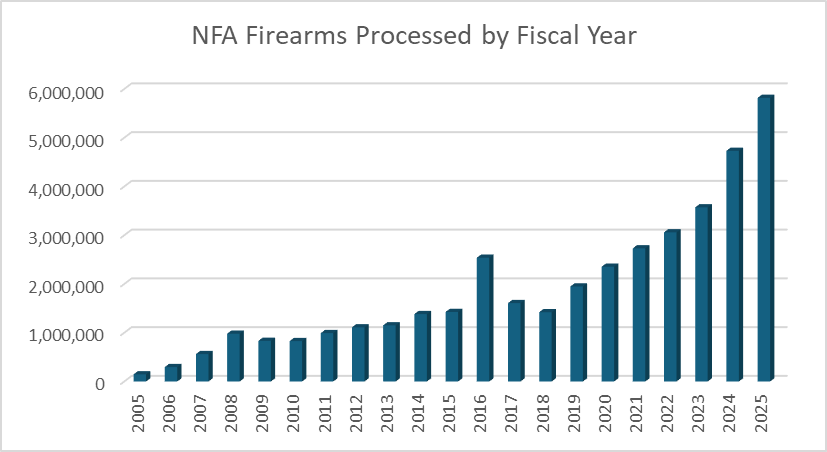
The Number of NFA Firearms Processed by Fiscal Year bar graph depicts the number of NFA firearms processed from applications captured in the NFRTR by Fiscal Year from FY 2005 to FY 2025; see table of data below.
Number of NFA Firearms Processed by Fiscal Year
| Fiscal Year | Firearms Processed |
|---|---|
| 2025 | 5,817,780 |
| 2024 | 4,731,918 |
| 2023 | 3,571,938 |
| 2022 | 3,059,054 |
| 2021 | 2,731,716 |
| 2020 | 2,353,436 |
| 2019 | 1,949,822 |
| 2018 | 1,422,353 |
| 2017 | 1,607,952 |
| 2016 | 2,538,397 |
| 2015 | 1,426,211 |
| 2014 | 1,383,677 |
| 2013 | 1,152,163 |
| 2012 | 1,112,041 |
| 2011 | 992,975 |
| 2010 | 828,462 |
| 2009 | 834,328 |
| 2008 | 981,303 |
| 2007 | 563,127 |
| 2006 | 296,127 |
| 2005 | 147,484 |
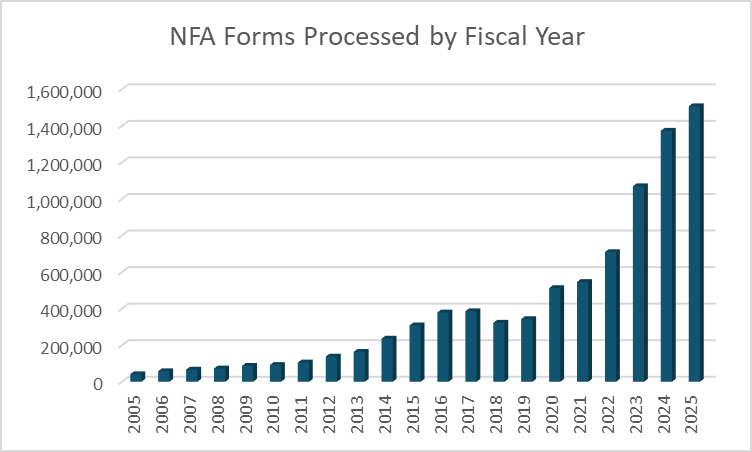
The Number of NFA Forms Processed by Fiscal Year bar graph depicts the volume of applications captured in the NFRTR that were processed by the NFA Division by Fiscal Year to include FY 2005 to FY 2025; see table of data below.
The Number of NFA Forms Processed by Fiscal Year bar graph depicts the volume of applications captured in the NFRTR that were processed by the NFA Division by Fiscal Year to include FY 2005 to FY 2025; see table of data below.
Number of NFA Forms Processed by Fiscal Year
| Fiscal Year | Forms Processed |
|---|---|
| 2025 | 1,507,443 |
| 2024 | 1,373,305 |
| 2023 | 1,069,787 |
| 2022 | 709,508 |
| 2021 | 546,224 |
| 2020 | 512,315 |
| 2019 | 342,860 |
| 2018 | 322,692 |
| 2017 | 386,210 |
| 2016 | 379,410 |
| 2015 | 308,563 |
| 2014 | 236,290 |
| 2013 | 163,691 |
| 2012 | 137,649 |
| 2011 | 105,373 |
| 2010 | 91,949 |
| 2009 | 86,753 |
| 2008 | 72,808 |
| 2007 | 66,560 |
| 2006 | 57,783 |
| 2005 | 41,579 |
Machineguns Registered in the National Firearms Registration and Transfer Record
In response to recurring Freedom of Information Act (FOIA) requests relating to this topic, ATF is making public the number of machineguns registered in the National Firearms Registration and Transfer Record (NFRTR) that are transferrable to private civilians. The NFRTR was established in 1934 with the passage of the National Firearms Act (NFA). Originally, the information was contained on note cards. While improvements and updates have been made, the NFRTR was not designed to facilitate broad searches for categories of information. It remains a name and firearm-based system that is used to determine whether a particular firearm with a particular serial number is registered to a particular person.
Accordingly, the total numbers of a particular type of weapon that were in the system at a given time cannot be determined with pinpoint precision. Moreover, the information in the NFRTR is not static, as firearms are removed and added on a daily basis. Even where ATF can ascertain the number of a particular type of weapon is on the NFRTR, it is important to note that this number is not the same as the number that is possessed by law-abiding individuals in the United States.
With these caveats, ATF can provide the following information:
As of June 2025, the total number of machineguns in the NFRTR is approximately 2,382,403. This number includes all machineguns registered in the NFRTR regardless of the applicant that registered the machinegun or the reason for the registration. For example, this number includes machineguns registered to government entities, as allowed by 18 U.S.C. § 922(o)(2)(a), machineguns registered to licensed entities that are allowed to hold an inventory of machineguns as sales samples for future sales to government entities, as allowed by 27 C.F.R. § 479.105, and machineguns registered to private individuals, as allowed by 18 U.S.C. § 922(o)(2)(b). Moreover, the number includes machineguns that have since been exported from the United States, as these records remain on the NFRTR. And this number includes machineguns that no longer function, such as deactivated war trophies. See 26 U.S.C. § 5845(a).
As of May 2024, the number of machineguns registered by state is approximately 782,958, as reflected in the “Firearms Commerce in the United States, Annual Statistical Update, 2024.” This number is lower than the total number of machineguns on the NFRTR because it does not include machineguns registered in a U.S. territory, machineguns where no state was listed, or machineguns that have been exported from the United States and so are no longer present in any state.
As of June 2025, of the total number of machineguns in the NFRTR, the number of machineguns that are registered in the NFRTR that are transferable to a private individual or between private individuals is approximately 234,718. As explained, these machineguns may no longer function, or they may be actually possessed by government entities, 18 U.S.C. § 922(o)(2)(a), licensed entities, 27 C.F.R. § 479.105, or individuals outside of the United States.
