



FEDERAL RULEMAKING PROCESS In U.S. administrative law, Congress delegates to executive agencies the authority to issue federal rules, which define how existing laws will be interpreted and enforced. Through the rulemaking process, agencies are required to seek and consider input from the public before implementing final rules. The process consists of six steps: 1. Agency creates draft proposed rule* 2. Agency issues a notice of proposed rulemaking in the Federal Register 3. The public comments on the proposed rule (normally, at least 30 days) 4. Agency considers comments and creates final rule 5. Agency issues final rule in the Federal Register 6. Rule goes into effect** Notes: * The Office of Information and Regulatory Affairs of the Office of Management and Budget reviews the draft proposed rule and manages inter-agency review. ** Regulations may be issued or revised due to changes in statute, executive order, technology, case law, and other similar reasons.
Federal Rulemaking Process
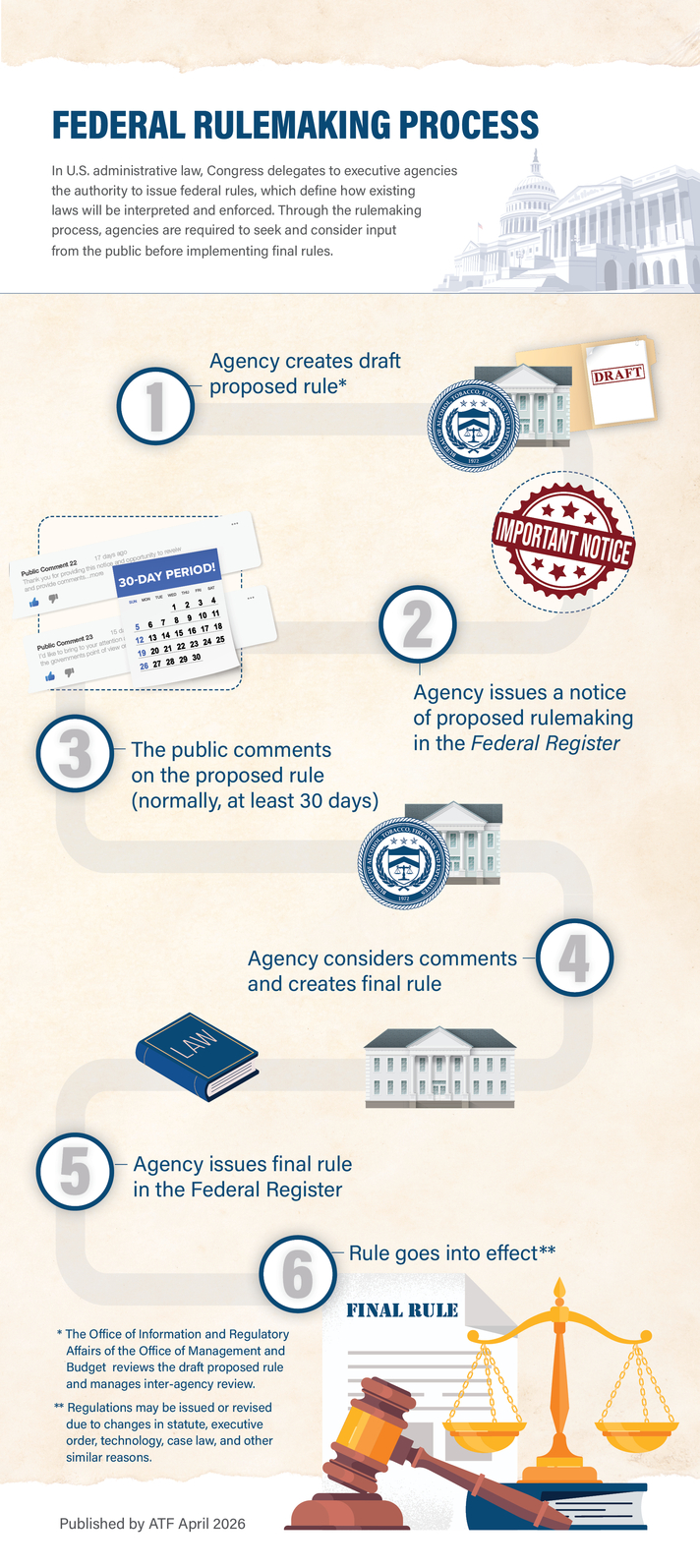
In U.S. administrative law, Congress delegates to executive agencies the authority to issue federal rules, which define how existing laws will be interpreted and enforced. Through the rulemaking process, agencies are required to seek and consider input from the public before implementing final rules.
The process consists of six steps:
1. Agency creates draft proposed rule*
2. Agency issues a notice of proposed rulemaking in the Federal Register
3. The public comments on the proposed rule (normally, at least 30 days)
4. Agency considers comments and creates final rule
5. Agency issues final rule in the Federal Register
6. Rule goes into effect**
Notes:
* The Office of Information and Regulatory Affairs of the Office of Management and Budget reviews the draft proposed rule and manages inter-agency review.
** Regulations may be issued or revised due to changes in statute, executive order, technology, case law, and other similar reasons.
Download :
 Infographic - Federal Rulemaking Process - April 2026.pdf
[PDF, 5.47 MB]
Infographic - Federal Rulemaking Process - April 2026.pdf
[PDF, 5.47 MB]
