


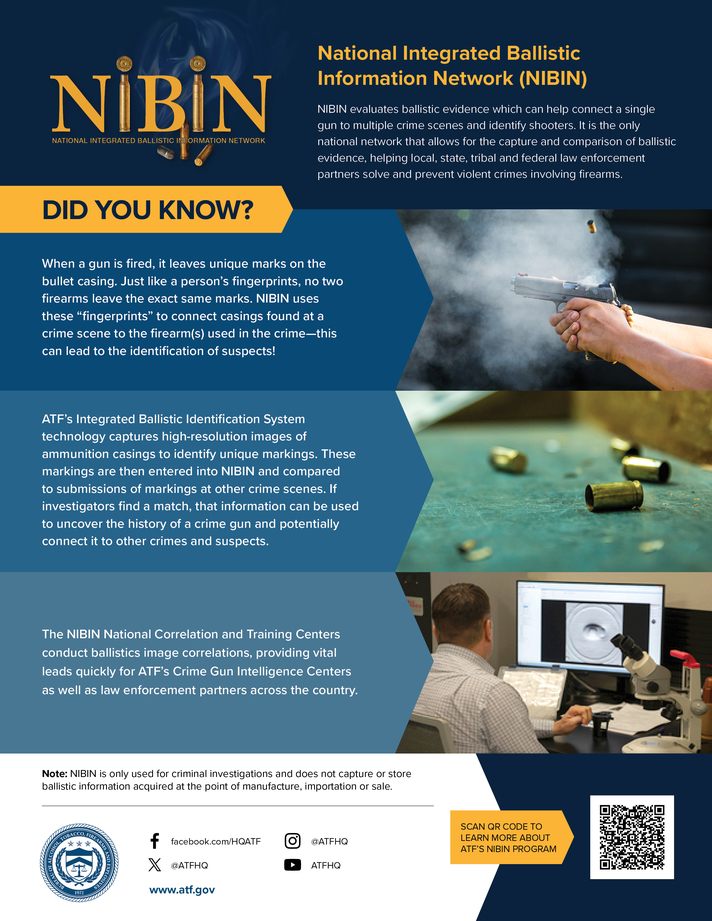
Infographic explaining the ATF's National Integrated Ballistic Information Network (NIBIN), which uses unique markings on fired cartridge cases to compare ballistic evidence, connect firearms to multiple crime scenes, identify potential suspects, and provide investigative leads to law enforcement.
National Integrated Ballistic Information Network (NIBIN)
NIBIN evaluates ballistic evidence which can help connect a single gun to multiple crime scenes and identify shooters. It is the only national network that allows for the capture and comparison of ballistic evidence, helping local, state, tribal and federal law enforcement partners solve and prevent violent crimes involving firearms.
Did You Know?
- When a gun is fired, it leaves unique marks on the bullet casing. Just like a person’s fingerprints, no two firearms leave the exact same marks. NIBIN uses these “fingerprints” to connect casings found at a crime scene to the firearm(s) used in the crime—this can lead to the identification of suspects!
- ATF’s Integrated Ballistic Identification System technology captures high-resolution images of ammunition casings to identify unique markings. These markings are then entered into NIBIN and compared to submissions of markings at other crime scenes. If investigators find a match, that information can be used to uncover the history of a crime gun and potentially connect it to other crimes and suspects.
- The NIBIN National Correlation and Training Centers conduct ballistics image correlations, providing vital leads quickly for ATF’s Crime Gun Intelligence Centers as well as law enforcement partners across the country.
Note: NIBIN is only used for criminal investigations and does not capture or store ballistic information acquired at the point of manufacture, importation or sale.
Visit the NIBIN webpage for more information.
Download :
 NIBIN-infographic_2026.pdf
[PDF, 2.18 MB]
NIBIN-infographic_2026.pdf
[PDF, 2.18 MB]
